
1. Rarin’ Aaron
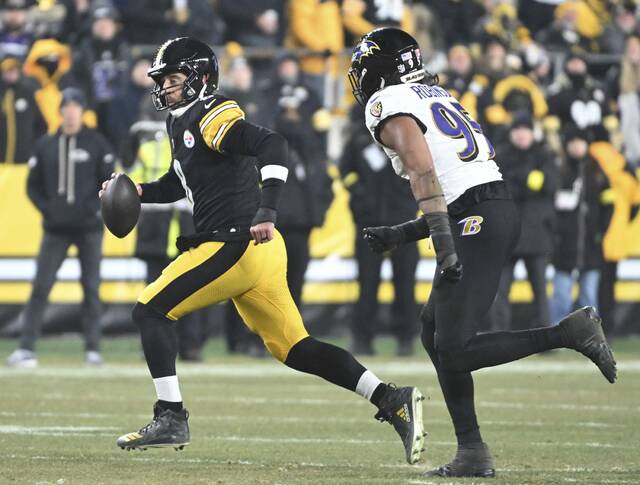
Aaron Rodgers turned 42 years old on Dec. 2. As the sun rose on that chilly Tuesday morning, the Pittsburgh Steelers’ season seemed to be cratering. And to some degree, so did the career of Rodgers, at least inasmuch as it could have careened to an uninspiring end.
Instead, since Rodgers turned 42 — only five quarterbacks in NFL history have started games at an older age — he has seemingly turned back to the clock. Rodgers might not be playing at the level he achieved as a four-time NFL MVP, but over the final weeks of the regular season he was playing his best sustained ball. And he had seemed to nudge himself into top-10 territory among the league’s quarterbacks over that span.
First, a look at Rodgers’ traditional stats over the Steelers’ final five games, during which they went 4-1 and claimed the AFC North title. Rodgers completed 66.5% of his passes, averaged 247.2 passing yards and 6.6 yards per attempt with five touchdowns, no interceptions and a 93.7 passer rating.
Rodgers and Josh Allen were the only quarterbacks (minimum four starts) in that time who did not throw an interception. (Rodgers has not thrown one since Nov. 9). Only six passers threw for more yards in that span.
Quantifying a quarterback’s success is difficult. But in Pro Football Focus grading, Rodgers ranked eighth among all QBs from NFL Weeks 15-18. His average ESPN QBR over that span was 51.4 — slightly above average — but what is more telling is that four of Rodgers’ top six QBR outings of the season came over his final five games (a “stinker” — as he put it — Dec. 28 in Cleveland the lone exception).
Furthermore, four of Rodgers’ top eight PFF game grades for the season have come since Dec. 7.
2. Eleven a stranger thing
Monday’s playoff opener could be a heavy Brandin Echols game for the Steelers. The team’s primary nickel/slot corner, Echols has not been deployed as much as he perhaps might have been otherwise because of the offensive preferences of the teams the Steelers have faced.
According to sumersports.com, only six teams played a smaller percentage snaps against offenses in “11 personnel” (a package of three wide receivers, one running back and one tight end on the field) than the Steelers.
“Eleven” — its name comes from the “1” running back and “1 tight end” — is considered the “standard” offense grouping in the modern NFL. It was deployed this season on 56.4% of plays. But the Steelers saw it just 50.8% of the time.
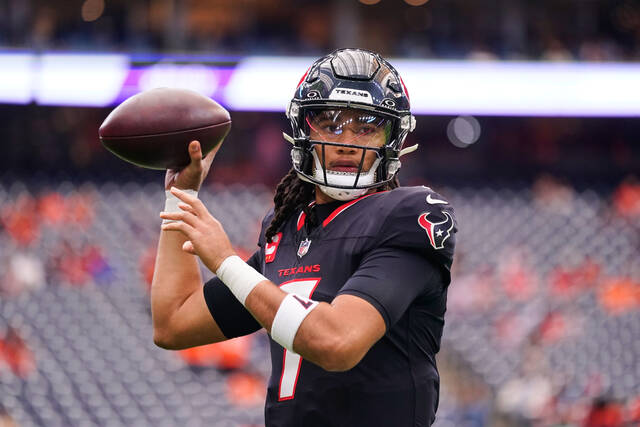
Enter the Houston Texans, the Steelers’ wild-card opponent and a team that deployed “11” personnel more than all but two teams. Though Houston has a star tight end in Dalton Schultz (82 catches), he was the only tight end to play more than 22.7% of the team’s offensive snaps. The Texans had the NFL’s second-lowest rate of “12” personnel (two tight ends), and seventh-lowest rate of “13” (three tight ends).
Among the eight teams that use “11” (three WRs) most often this season, the Steelers faced only one (the New York Jets way back in Week 1). Aside from themselves — the Steelers’ offense went “11” at the second-lowest rate in the league — the Steelers played nine games against offenses that rank among the bottom 10 in “11” usage.
3. Scoring away from home
The legal betting markets in the days leading up to Monday’s game had pegged the line for the Texans’ team point total at 20.5. Based on their season, don’t bet on hitting the “over.”
Only once in eight road games this season has Houston eclipsed 20 points — back on Oct. 5 in Baltimore. Taking away that 44-point outburst, the Texans averaged just 16.2 points per game away from NRG Stadium. Even counting that game against the Ravens, their 19.8 road points per game would rank 26th in the league.
Overall counting home games, Houston’s 23.8 points per game ranked 13th in the league. The Steelers, incidentally, were just a tad behind at 23.4 for 15th.
Defensively, the Steelers finished 2025 allowing the 17th-most points (22.8), including 21.1 in games at Acrisure Stadium.
4. Run game reversal
While the numbers overall still won’t ever be confused with elite production, the Steelers on both sides of the ball have improved in the running game as the season winded down.
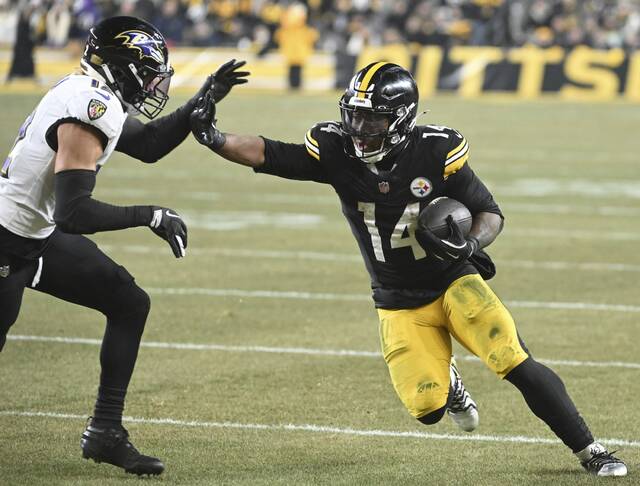
Over the final four games of the season, the Steelers’ offense averaged 149.0 rushing yards and had six rushing touchdowns. Their opponents, meanwhile, averaged 73.5 rushing yards and no rushing touchdowns. Over the course of the full season, that would rank the Steelers No. 3 in the NFL in rushing yards and No. 1 in rushing defense.
Because of poor starts in both areas, though, the Steelers will finish the 2025 season ranked 26th overall in rushing offense and 13th in rushing defense. But to show the improvement consider that as recently as one month ago they were No. 21 in the NFL in rush defense and No. 29 in passing defense.