
https://emergency.triblive.com/news/pennsylvania/narcan-in-schools-educators-react-to-proposed-legislation/
Narcan in schools? Educators react to proposed legislation

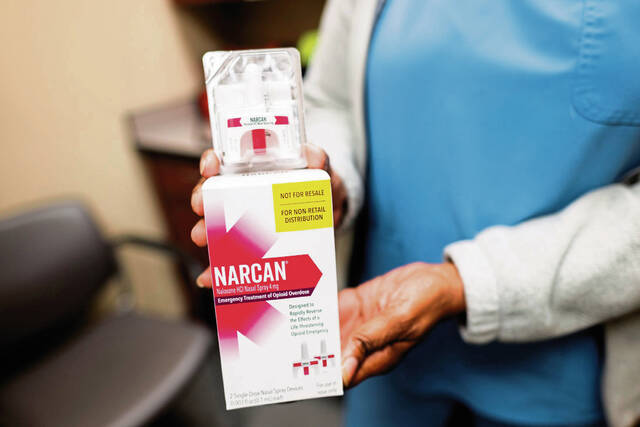
Public school officials statewide administered medication to reverse an opioid overdose 32 times during the 2023-24 school year, according to the Pennsylvania Department of Health.
Who received the naloxone dose and in which schools it was administered were not made public by the health department. But the growing impact of opioid abuse, and fentanyl in particular, prompted two Philadelphia-area lawmakers in October to introduce legislation that would require schools to stock naloxone and provide training to at least one volunteer — a school nurse or other employee — on how to use the antidote.
Almost every school district contacted by TribLive for this story already stocked naloxone in its schools, officials said, some for more than a decade. Opinions varied over the proposed law and whether school workers were best equipped to handle such medication.
All appeared to believe that having naloxone — perhaps best known by its brand name Narcan — on hand was a good step in helping keep their students safe.
This year alone in Pennsylvania, law enforcement has seized more than 50 million doses of fentanyl, nearly 18 million in the greater Pittsburgh area, state Attorney General Dave Sunday said in October.
“(Opioid pills are) making their way to … schools and colleges,” he said. “They’re in parties, and it’s unbelievably dangerous.”
How we got here
There were 26 reported incidents where naloxone or a similar drug was administered in public schools statewide in 2021-22 and 38 during the 2022-23 school year, said Eli Steiker-Ginzberg, a spokesman for the state Department of Health.
Steiker-Ginzberg said he would not provide a breakdown of overdose cases by school or county in order to protect the confidentiality of individuals, because there were fewer than five per year in the counties.
“I think students deserve to be protected, and they deserve to be safe in school. And there are lots of ways that our society fails in that regard,” said Nikil Saval, D-Philadelphia, who joined fellow state Sen. Christine M. Tartaglione, D-Philadelphia, in introducing the bill. “But you know, I think that this is a simple way to ensure that people, that students’ lives, are protected when they’re in school.”
The idea behind the legislation came from University of Pennsylvania’s Forum for Legislative Action students — Madeleine Berg, 19, Leonardo Ding, 19, Elli Jin, 20, and Neha Kirshna, 21 — who presented their proposal in Harrisburg in the spring as part of their group’s curriculum.
Although members said they have not experienced peers struggling with addiction or witnessed anyone needing Narcan, Berg said she is aware of teenagers and young adults who are impacted by fentanyl through stories from family members who work in health care.
When crafting their proposal, the Penn students said they were worried about overloading teachers with another job. So in collaboration with legislators, they decided the bill would require training on a volunteer basis.
“Public school teachers already have so much responsibility, and it was important to us that we didn’t burden them in any way,” Berg said.
Sen. Wayne Fontana, D-Brookline, who is a bill co-sponsor, said the goal is to create a unified process and procedure on how public schools should respond to drug overdoses.
At the moment, the bill does not outline specific guidelines about how much naloxone schools would be required to carry, but it could be amended. The bill remains in committee in the Senate.
Stocked and ready
Penn-Trafford School District has stocked naloxone in every school for more than 10 years, Superintendent Matt Harris said. It’s provided for free by Westmoreland Drug and Alcohol.
“Luckily, we have never had to use it,” Harris said.
Burrell School District Superintendent Shannon Wagner said she has reservations about what lawmakers are proposing.
“I would prefer not to have it,” she said. “I would rather have emergency personnel come in and administer it.”
Wagner said Burrell’s school resource officer carries Narcan and knows how to administer it but has never had to use it at school. She believes prevention is more important and medical personnel are the experts in an overdose situation.
“If we’re required to do it, we’ll do it,” she said.
Policies in place
The Kiski Area School Board approved a policy in November that outlined naloxone in the school district, Superintendent Jason Lohr said.
Kiski Area’s policy requires Lohr, school nurses and the school physician to establish procedures and guidelines for overdose reversal drugs. The nurse is to annually inform all guardians, students and staff about the policy.
Employees must complete a state Health Department training program before carrying or administering overdose reversal drugs, the proposal says. It outlines where it can be stored and how people should administer it.
The school would report incidents to police and the students’ parents, and the students would be referred to the student assistance program.
“Our board wanted to be proactive in this area before we were confronted with an emergency requiring its use,” Lohr said. “Currently, our school resource officers have access to Narcan.”
Greensburg Salem School District has had a naloxone policy since 2016, according to Todd McMillen, director of student services. The district stocks naloxone in all school buildings. Greensburg Salem spokeswoman Kayla Tamer declined to comment on the district’s opinion on the lawmakers’ proposal.
Bethel Park School District Superintendent James Walsh said the district did not have a policy but believes “availability is a proactive step in addressing the wider opioid epidemic and provides a layer of protection for schools,” according to a prepared statement.
Franklin Regional School District has had naloxone available in its schools for about 10 years. Superintendent Gennaro Piraino said school police officers and nursing staff are trained and equipped to use it.
“We recognize that an opioid-related medical emergency can occur intentionally or unintentionally, can involve legal or illegal substances, and can affect a student, staff member or visitor,” Piraino said. “If an overdose or exposure occurs, we want to be able to respond immediately. Having Narcan accessible is one of the many steps we take to protect the health, safety and welfare of our school community.”
Lauren Madia, director of pupil services for Upper St. Clair School District, said the district has stocked Narcan since 2019 but has not had to administer it. She said she did not realize there was not a state mandate in place for schools to have Narcan.
“It’s just something that seems like standard practice,” she said.
Copyright ©2025— Trib Total Media, LLC (TribLIVE.com)