
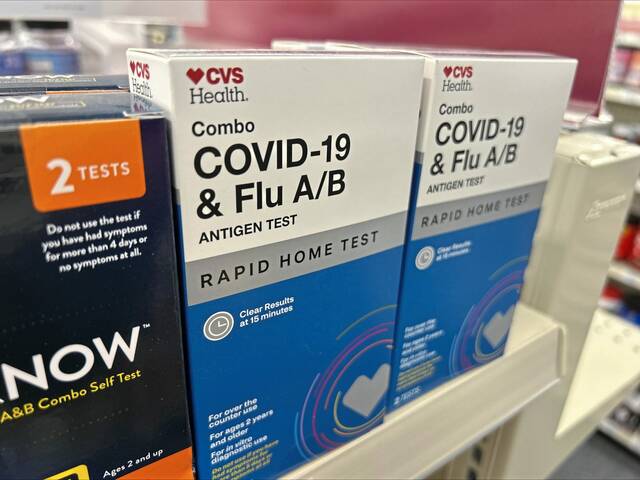
Flu infections are surging across Pennsylvania.
The state’s Department of Health has logged more than 35,000 cases since the start of October, with nearly 14,000 coming between Dec. 21 and Saturday.
Department spokesman Neil Ruhland described the rise as a “normal annual occurrence” caused by people spending more time indoors, where transmission is more likely. The flu outbreak is nonetheless a serious public health concern.
Almost 7% of emergency room visits over that weeklong span were attributed to the respiratory virus, which can be more severe in young children, older adults, people with underlying health conditions and those who are unvaccinated.
In addition, the National Center for Health Statistics has logged 22 flu deaths in Pennsylvania. The virus, which is marked by fever, muscle aches and a dry cough, can turn deadly through complications like pneumonia or sepsis.
Doctors say they’re managing the influx of flu patients.
“Right now, they’re not in any sense overwhelming for us,” said Dr. Ezz-Eldin Moukamal, chief quality officer at the Allegheny Health Network.
Allegheny Health Network had 158 patients hospitalized with a respiratory illness as of Tuesday, including 107 with the flu.
Admissions related to the disease were concentrated at Forbes Hospital in Monroeville and Jefferson Hospital in Jefferson Hills. Moukamal believes these hot spots were caused by a high number of older residents in the surrounding areas.
He emphasized the Allegheny Health Network has precautions in place to limit the disease’s spread within hospitals, and patients with other conditions should not be discouraged from seeking care.
At UPMC-GoHealth Urgent Care centers, about half of all patients in December sought care for an upper respiratory illness, including the flu, officials said.
West Virginia University Health System’s Uniontown Hospital was treating almost 20 patients for flu or covid-19 Wednesday.
“It seems like there’s been a significant increase here over the last one-to-two weeks,” said Dr. Neal Baker, who oversees Uniontown Hospital’s emergency room.
Looking statewide, flu case rates are higher in Eastern Pennsylvania and the Erie area, though Allegheny and Butler counties are also seeing above-average flu circulation.
Pennsylvania, as a whole, is seeing only “moderate” levels of transmission, according to the Centers for Disease Control and Prevention, despite several neighboring states being in the grips of severe outbreaks. New York saw 71,000 flu cases between Dec. 14 and Dec. 20, according to the state’s health authorities — the most ever recorded.
Flu infections historically climb around December, briefly fall off and then tick back up by the end of February, according to Pennsylvania Department of Health data. Infections usually subside to very low levels in May.
It’s tough to know exactly how the rest of this flu season will shake out, according to Dr. Donald Yealy, UPMC’s chief medical officer and chair of the Pennsylvania Board of Medicine. But there does not appear to be anything catastrophic on the horizon.
“It’s not likely to be the worst that I’ve seen in my practice,” he said.
Cases of respiratory syncytial virus (RSV) are also climbing in Pennsylvania, though not as quickly as the flu. The state’s respiratory virus dashboard does not track deaths from RSV.
It also does not include covid-19 cases, but hospitalizations were trending upward as of the week ending Dec. 13. The virus has killed 145 Pennsylvania residents this season, according to the National Center for Health Statistics.
‘Super’ flu?
As for the flu, it appears a variant known as subclade K is fueling the rise in cases.
Scientists first documented the strain after the season’s flu shots were formulated, raising concerns it could slip past the vaccine’s defenses.
Since September, subclade K has accounted for 89% of the nation’s H3N2 cases — the most common category of flu — according to the Centers for Disease Control and Prevention.
Yealy downplayed fear around the variant, which has been nicknamed “super K” by some.
It’s not unusual for a new strain to appear, he said. And regardless of the specific type of flu, doctors treat the disease the same way.
Dr. Amesh Adalja, a Pittsburgh-based infectious disease specialist and senior scholar at the Johns Hopkins Center for Health Security, said there’s no indication subclade K is particularly severe or contagious.
But it is spreading quickly, and that’s because people lack immunity to this specific variant, he said.
The mismatched flu shot isn’t helping.
When the prevailing strain isn’t included in the vaccine, it becomes less effective at preventing infection, Adalja said.
But public health authorities say the annual shot, which is still available at doctors’ offices, clinics and pharmacies, appears to be holding up as usual against severe illness and death.
“Suffice it to say, the next version of the vaccines are going to have subclade K in them, unless something changes,” Adalja said.