For a problem as big as climate change, it’s the local things that matter.
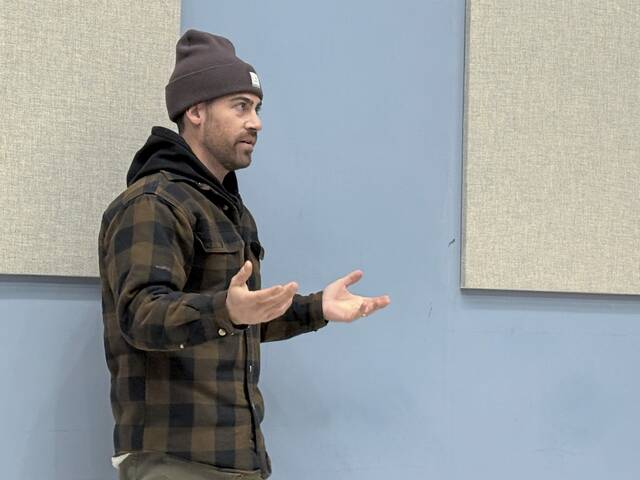
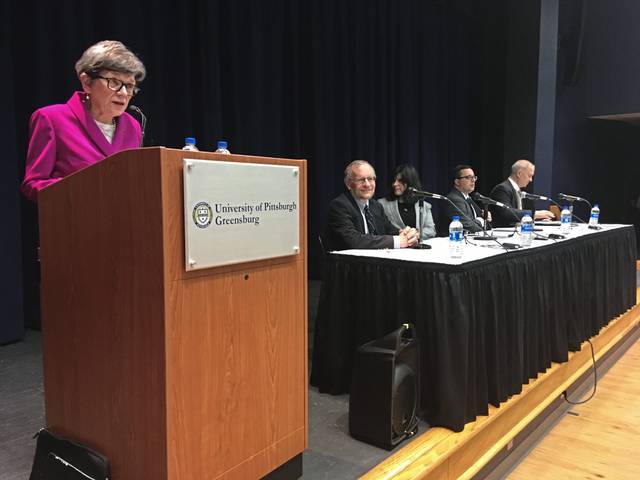
That was the consensus from a panel discussion on “Climate Change and Its Effect on Western Pennsylvania” held Tuesday at the University of Pittsburgh-Greensburg.
The panelists, participating in the 14th annual Dr. Bernard Cobetto Lecture Series on Contemporary Ethical Issues, represented the sciences, the city of Pittsburgh and Peoples Gas.
Grant Ervin, chief resilience officer for the Pittsburgh Department of City Planning, touted the city’s Climate Action Plan 3.0, which sets emission reduction goals for city buildings, transportation, waste disposal and energy use by 2030.
“Local government, in particular, has a moral imperative to act on climate change,” Ervin said. “Whether you’re a city the size of New York City or North Versailles Township, you have a reason to help do those things for the residents that live in your community.”
Ervin said Pittsburgh is trying to set an example for other Pennsylvania municipalities that are looking at climate mitigation strategies.
“I can tell you emphatically that it’s possible,” he said. “It’s those decisions we make with regard to purchasing that can transition us to a lower-carbon economy that is healthier and better for our society.”
Ervin said 80% of greenhouse gas emissions in Pittsburgh come from buildings, 19% come from transportation and 1% comes from waste.
Barry Kukovich, Peoples Gas community relations director, said the effects of climate change are a weekly reality for the utility.
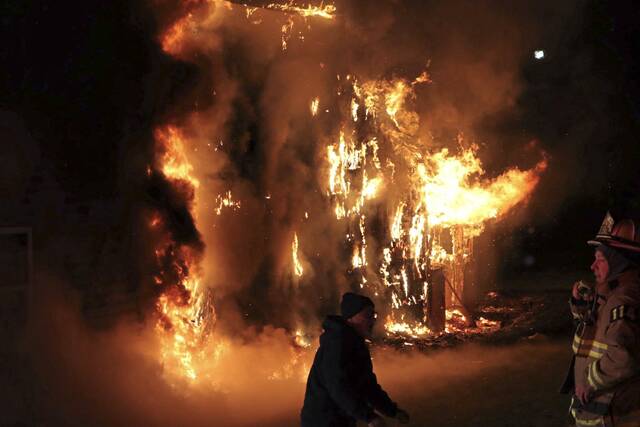
The number of landslides caused by freeze-thaw cycles has grown from one in 2011 to 26 in 2018, Kukovich said. “I believe we will go past 30 this year,” he said. “It’s the worst kind of nightmare for a gas company.”
Such cycles cause underground pipes to move, which can create breaks and leaks that require a response from the gas company, he said.
“Climate change is here. We’re dealing with it in Allegheny County, in Westmoreland County, in Washington County every week,” Kukovich said.
In January, Peoples announced plans to cut methane emissions from its Pittsburgh distribution system by 50 percent by the end of the year using new leak detection technology.
Methane, the main ingredient in natural gas, is considered a potent greenhouse gas with more than 80 times the warming power of carbon dioxide in the first 20 years it is in the atmosphere, according to Peoples.
Kukovich said Peoples also is testing a new fuel cell device that converts natural gas into electricity for individual homes. Three of the WATT Fuel Cells have been installed in homes in Westmoreland County so far.
“These homes are creating their own electricity from our natural gas. They’re also compatible with solar cells, so you can have electricity from both sources — all produced on-site,” he said.
Addressing the bigger picture were panelists Richard Alley, professor of geosciences at Penn State University, and Ines Azevedo, professor of engineering and public policy at Carnegie Mellon University.
On the question of whether there is still time to take action on climate change, both scholars said it’s not too late.
“We’re missing the window to make that transition — it’s closing,” Azevedo said. “The reason for it closing has nothing to do with technology. It has nothing to do with economics. It has to do with people.”
“We have made the job harder by not starting sooner,” Alley said.
The panelists also discussed market-based solutions, the impact of the oil-and-gas and petrochemical industries in Western Pennsylvania, U.S. dependence on fossil fuels, and renewable sources of energy.
At the question-and-answer session, audience members expressed frustration over everything from their neighbors not understanding the scope of the problem to a lack of bold initiatives from the federal government.