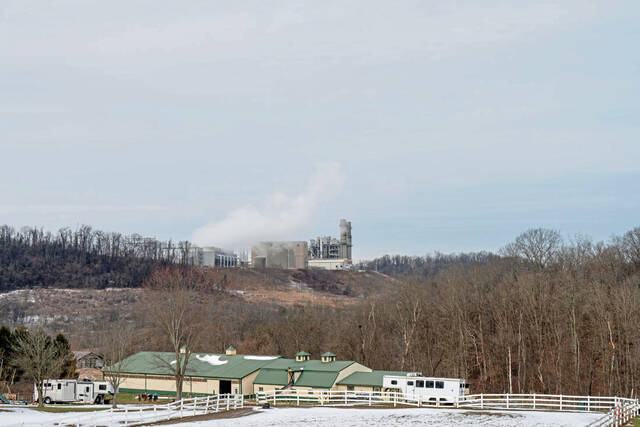
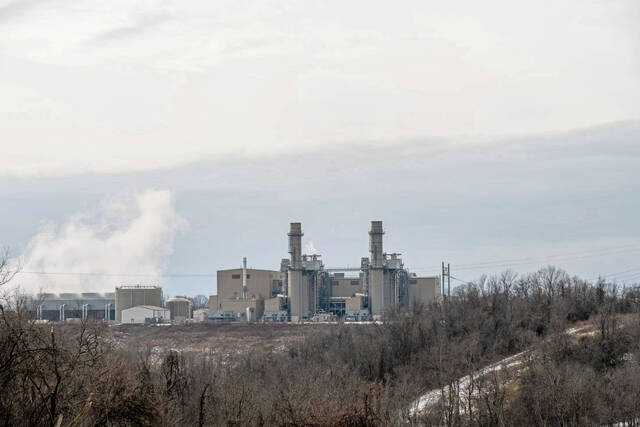
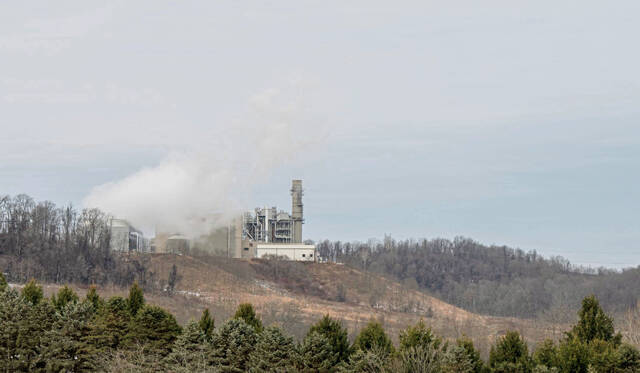
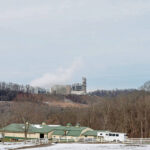
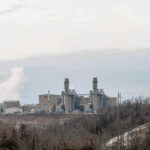
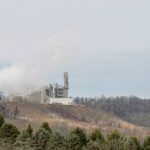
From his Mendon Road horse farm, Eric Metz watches white clouds billow daily from the 940-megawatt natural gas power plant looming over South Huntingdon.
“It’s really not a problem,” Metz said of the emissions drifting from the Tenaska Westmoreland Generating Station over his property.
The health of the 23 horses boarded in his Sun Hill Quarter Horse stables hasn’t been impacted by the plant, Metz added.
The facility near Smithton is a source of nitrogen oxide, carbon monoxide and volatile organic compounds, according to Tenaska Pennsylvania Partners LLC’s application to the state Department of Environmental Protection.
The emissions also contain sulfuric acid mist and an estimated 3.7 million tons of carbon dioxide annually, according to the permit application.
Tenaska has applied for an operating permit that requires the plant to monitor and report emissions to ensure compliance with state and federal air quality standards.
Tenaska Pennsylvania Partners includes affiliates of Nebraska-based Tenaska and two Japanese firms — a Mitsubishi subsidiary and a Tokyo-based power plant developer.
The plant’s emissions and operations will be the focus of a DEP public hearing from 5 to 7 p.m. Feb. 4 at Huntingdon Place, the Turkeytown fire department’s social hall along Route 31 in South Huntingdon.
While the DEP stated its intention last year to approve the permit, the facility has been operating under an initial construction and operating permit issued in 2015. The plant began producing power in December 2018, and the company applied for this latest air quality permit in July 2024.
Leighton Eusebio, a spokeswoman for Tenaska Pennsylvania Partners LLC, could not be reached for comment.
Support for public hearing
Em Hough, a community organizer for the Melcroft-based Mountain Watershed Association, said it was appropriate for the DEP to hold a public hearing “for this long-overdue operating air permit.”
The Environmental Integrity Project in Pittsburgh has objected to the DEP’s draft permit, arguing it lacks sufficient monitoring requirements to ensure the plant complies with the Clean Air Act. Under federal law, a Title V Operating Permit must include specific and frequent monitoring to prove a facility is meeting its emissions limits.
“It must abide by the federal Clean Air Act,” said Lisa Graves Marcucci, community outreach coordinator for the Environmental Integrity Project. “This is incredibly long (for a draft permit). That should never happen. It’s outside of the norms.”
Further down Mendon Road, neighbor Chris Krepps said he also has no issues with the facility.
“There’s no pollution. There’s no smell. It’s quiet down here,” said Krepps, whose view of the plant is blocked by a ridgeline.
In its objections, the Environmental Integrity Project clarified it does not seek to close the plant but rather to strengthen permit requirements.
In addition to air quality, the DEP is taking comments Feb. 4 regarding the renewal of Tenaska’s water permit.
The facility seeks to discharge 1.2 million gallons of water per day into the Youghiogheny River, consisting of water from cooling towers, wastewater and stormwater impacted by industrial activity.
The DEP will consider and respond to comments at the hearing and those received within 10 days, making a decision once the comments are evaluated, said Laina Aquiline, a DEP spokeswoman.