

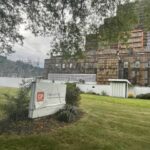
On the morning of June 2, Joe Kern took to his Duquesne Court home’s roof and decided to film Springdale history, waiting for the two towering smokestacks at the former coal-fired power plant across the street to be imploded.
But when the towers fell, a cloud of brown dust absorbed the neighborhood, and he had to flee to safety.
Kern, his family and some of his neighbors say that demolition caused health problems and damage to their properties.
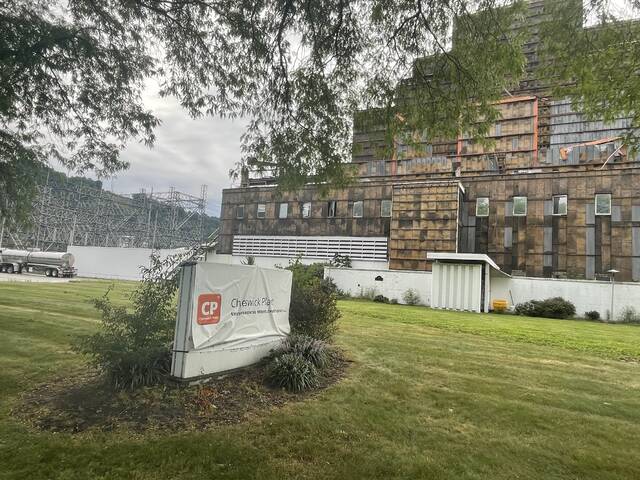
On Monday, 16 Springdale residents filed a lawsuit against Charah Solutions, the owner of the former Cheswick Generating Station property, and the parties that handled the implosion: Controlled Demolition Inc., Grant Mackay Co. and Civil and Environmental Consultants Inc.
They also seek to halt a planned implosion of the plant’s boiler house, which was scheduled for Friday morning but stopped because of the lawsuit.
Kern’s video, which he posted to Facebook, was viewed in Judge John T. McVay Jr.’s courtroom Friday, as some of the other plaintiffs shook their heads in dismay.
“It felt like it was never going to stop,” Kern said of the dust cloud.
McVay continued the hearing until 9 a.m. Tuesday.
Allason Holt, an enforcement manager with the Allegheny County Health Department’s air quality program, testified on Friday that her department found the initial dust mitigation plan for the June 2 implosion to be sufficient.
However, given the results that day, they imposed stricter conditions for the boiler house implosion.
“The dust mitigation plan submitted for the boiler house was more robust than the stack implosion,” Holt said.
Those stricter requirements include that the demolition can’t take place if winds are more than 25 mph, or if it is an “Air Quality Action Day” as determined by health officials. Contractors also are supposed to demonstrate the use of water cannons to health officials before the implosion.
Additionally, Holt confirmed that all of the asbestos permits were closed regarding the boiler house.
Grant Mackay also said in the boiler house dust mitigation plan it would remove the fiberglass insulation from the perimeter of the boiler house, wash down the inside of the boiler house and use a street sweeper, soil stabilizer, on-site water cannons and a water truck for the building’s implosion.
Holt said that she, along with some others in the health department, were at the scene for the June 2 implosion and saw the results on Pittsburgh Street, and people’s homes and yards.
She said the health department did not collect measurements of the dust cloud following the smokestacks’ implosion.
Kern said the dust cloud funneled through his neighborhood and seemed like it would never end. He and his daughter began to suffer eye problems after the implosion, he testified.
About a week after the smokestacks’ implosion, an inspector with the state Department of Environmental Protection tested the dust that landed on Kern’s property, he said. An Aug. 2 letter from the DEP found that levels of arsenic received from Kern’s property were almost three times as high as state standards for residential direct contact use, and the levels of the chemical vanadium were almost double those standards.
“Everything got the arsenic on it, and everything got the lead on it. … Everything’s damaged,” Kern said.
But defense attorney Julie Brennan, who represents Grant Mackay, pointed to language in that letter that stated the concentration of vanadium in the sample is “well below” the revised state health standard. It also said that “somewhat elevated” arsenic levels, be it the result of natural soil conditions or other factors, is not uncommon in Southwestern Pennsylvania.
Kern’s next door neighbor, Kevin Keener, testified he, his wife and his daughter also had negative health effects as a result of the implosion. He wasn’t home during the blast, but when he was driving back, he noticed it was “real hazy” in Harmar.
“The amount of debris and dust was overwhelming,” he said.
Other neighbors testified their homes have damage as a result of the implosion and said they are concerned for their health and their homes if the boiler house blasting proceeds.
Stacy Ansell of Washington Street “most definitely” noticed damage to her home from the first implosion. Some of the damage to her property includes a crack in her basement’s concrete floor that continues to get wider, she said, and her back deck has a “funhouse” type of effect, no longer being a flat surface.
The implosion negatively impacted her, her husband and their 19-year-old daughter, she said.
D.J. Vasil said he and his wife planned on having and raising children in their Washington Street home, but as of now, it doesn’t feel safe.
“It looked like a tornado,” Vasil said of the first implosion. “It looked almost like a war zone, like Godzilla went through Springdale.”