
A new state law promotes Alzheimer’s awareness and, its backers say, will help provide assistance to families impacted by it and other degenerative diseases.
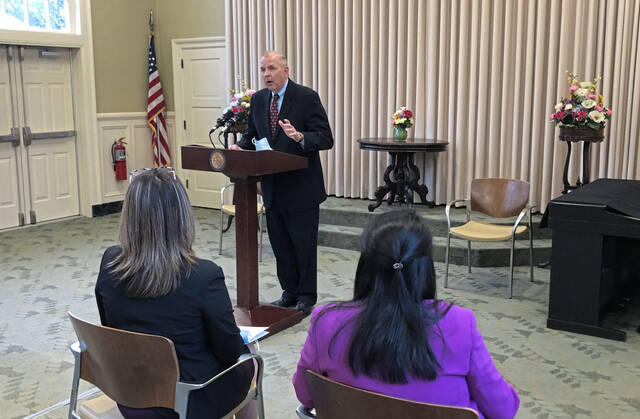
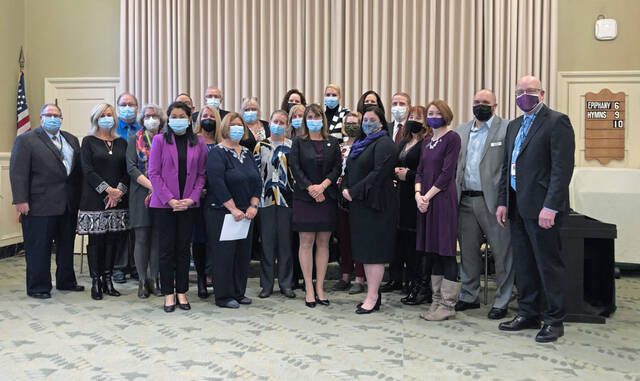
Local health care leaders and other officials gathered Thursday at Presbyterian SeniorCare Network’s facility in Oakmont to celebrate the Early Detection and Diagnosis of Alzheimer’s or a Related Disorder Act.
The bill was authored last year by state Rep. Carrie Lewis DelRosso, R-Allegheny/Westmoreland, and signed by Gov. Tom Wolf earlier this month.
“The early detection of Alzheimer’s disease is absolutely critical,” said Jim Pieffer, president and CEO of Presbyterian SeniorCare Network. “In our work, we see all the time how underdiagnosed Alzheimer’s disease is and its impact on individuals living with the disease and their families.”
Alzheimer’s causes cognitive decline and memory impairment, behavioral and psychiatric problems, and loss of ability to care for oneself.
DelRosso, an Oakmont resident and former borough councilwoman, said the law creates a structure to unite patients and health care providers around cognitive concerns that will lead to an earlier diagnosis.
The Alzheimer’s Association Greater Pennsylvania Chapter, as well as other public and private organizations with expertise in cogitative decline, will work with the state Department of Health and the state Department of Aging to develop a “toolkit.”
That kit would provide “best practices and cognitive assessment tools including the use of appropriate diagnostics to assist the primary care workforce in the detection, diagnosis, treatment and care planning for individuals with Alzheimer’s disease,” the bill read, in part.
The state also would post information online about understanding cognitive decline, Alzheimer’s or related disorders, including the difference between normal cognitive aging and dementia.
DelRosso said she was inspired to do something about cognitive disorders after the death of one of her friend’s mother, who passed a few years after being diagnosed with Lewy body dementia.
“It happened so quickly, so rapidly,” DelRosso said. “This woman was a professor. It turned her life around. This was my way, and (that of) the Alzheimer’s Association, of looking at some sort of a toolkit that health care providers can use in their preventative care models to actually help people.”
Jen Ebersole, Alzheimer’s Association state government affairs director, said she reached out to DelRosso, as the group does with all newly elected legislators, and the two really connected on promoting education.
“We hear time and time again that physicians feel like they’re on the front lines of diagnosing, but yet not all are equipped with the education or the tools to make a proper diagnosis,” Ebersole said. “It’s about having the cognitive assessments available, best clinical practices available, to actually do the assessment and make that diagnosis, and care referral information.”
Alzheimer’s Association Greater Pennsylvania Chapter executive director Clay Jacobs talks statistics and importance of early detection of the disease. pic.twitter.com/y8TqWVOi2x
— Mike D. (@MikeJdiVittorio) February 18, 2022