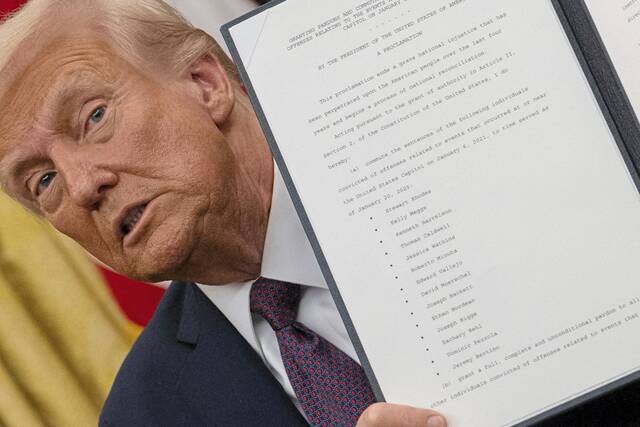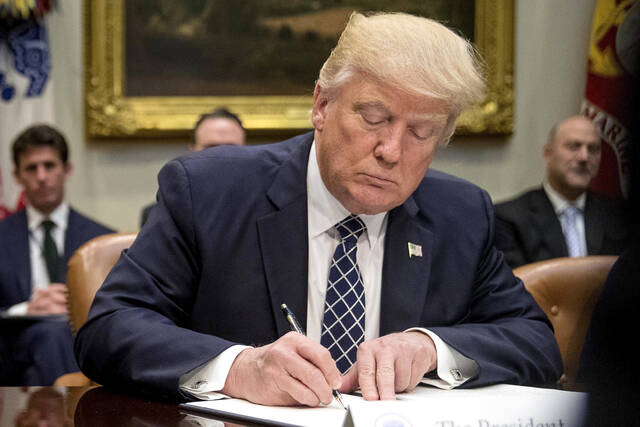
WASHINGTON — Donald Trump is returning to the White House ready to immediately overhaul the government using the fastest tool he has — the executive order.
He’s looking on his first day to increase domestic energy production and stop diversity, equity and inclusion programs within the federal government, among other actions.
An incoming president signing a flurry of executive orders is standard practice. Executive orders allow a president to wield power without action from Congress. But there are also limits to what orders can achieve.
A primer on how the presidential power works and its often fleeting impact:
What are executive orders?
Basically, they are signed statements about how the president wants the federal government to be managed. They can be instructions to federal agencies or requests for reports.
Many orders can be unobjectionable, such as giving federal employees the day after Christmas off. They can also lay out major policies. For example, President Joe Biden signed an order to create a structure for establishing regulations on artificial intelligence. But executive orders — and their policy sausage-making siblings, the proclamation and political memorandum — also are used by presidents to pursue agendas they can’t get through Congress.
New presidents can — and often do — issue orders to cancel the orders of their predecessors.
As the American Bar Association notes, the orders do not require congressional approval and can’t be directly overturned by lawmakers. Still, Congress could block an order from being fulfilled by removing funding or creating other hurdles.
How common are executive orders?
Throughout U.S. history, there have been several thousand executive orders, according to data collected by the American Presidency Project at the University of California, Santa Barbara. George Washington signed eight executive orders, while Franklin Delano Roosevelt did 3,721.
During his first term, Trump, a Republican, signed 220.
Biden, a Democrat, signed 160 as of Dec. 20.
Political messaging
Trump forecasted signing as many as 100 executive orders on his first day, possibly covering deportations, the U.S.-Mexico border, domestic energy, Schedule F rules for federal workers, school gender policies and vaccine mandates, among other Day 1 promises made during his campaign. He’s also promised an executive order to give more time for the sale of TikTok.
Trump had asked Rep. Jeff Van Drew, R-N.J., to write an order stopping the development of offshore windmills for generating electricity. But it’s entirely possible that Trump could also roll out many planned executive orders over time.
Many of Trump’s measures are likely to draw Democratic opposition.
And in several major cases, the orders will largely be statements of intent based off campaign promises made by Trump.
Limits to the power of executive orders
Both Congress and the courts can potentially block executive orders.
For example, Congress in 1992 revoked an executive order by then-President George H.W. Bush that would establish a human fetal tissue bank for scientific research by passing a measure that the order “shall not have any legal effect.” Congress can also deny funding to agencies and hamstring the enforcement of an order.
There are also legal challenges based on the argument that a president exceeded his legal authorities. When President Harry Truman tried to seize steel mills during the Korean War, the U.S. Supreme Court said he lacked the authority to take private property without authorization from Congress.