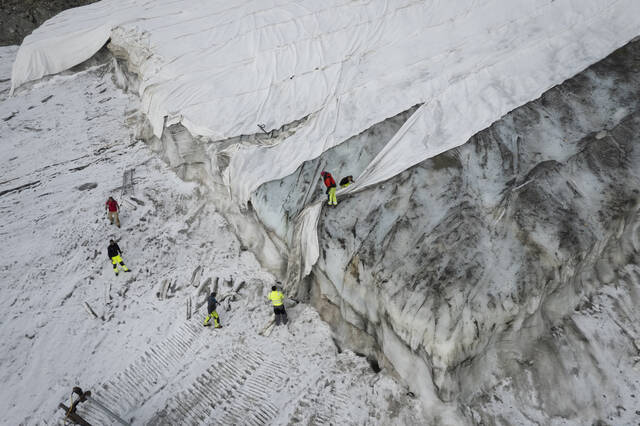
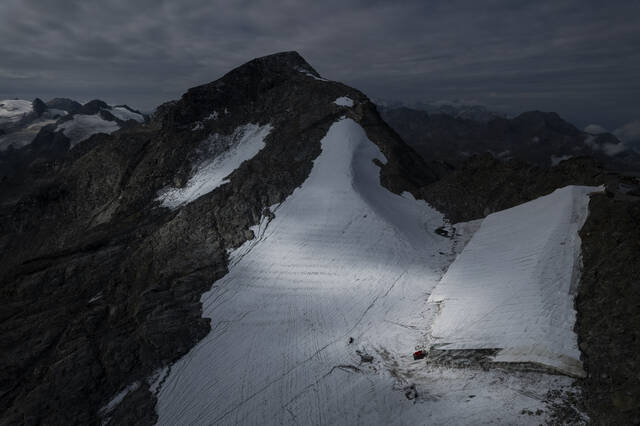
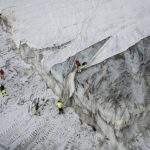
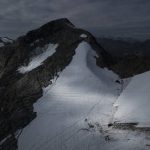
GENEVA — Switzerland’s glaciers are melting like never before, an academic study released Wednesday found, with their ice volume declining by 6% this year amid rising concerns about global warming and a summer heat wave that swept across Europe.
The Swiss Academy of Sciences reported that the shrinkage of ice in the country’s glaciers topped a previous record retreat nearly a generation ago.
“2022 was a disastrous year for Swiss glaciers: all ice melt records were smashed by the great dearth of snow in winter and continuous heat waves in summer,” the academy said in a statement.
The academy based its report on data collected by Glamos, the Swiss glacier-monitoring network. Switzerland has the greatest volume of glaciers of any country in Europe.
Matthias Huss, a glaciologist with the Federal Polytechnic Institute in Zurich who heads the Glamos program, says there’s “zero chance” the glaciers will return for decades — at best — given current projections for global temperatures.
“We have a series reaching back for more than 100 years, and we have never seen anything that is comparable to this year,” he said by phone. “It’s something that has been expected for the future that such extremes might come along, but now they are already here.”
Switzerland faced an “unlucky combination of factors” this year that led to the big melt, Huss said. Snow cover in the Swiss Alps was exceptionally light, particularly in the southeast, meaning that the glaciers had less natural protection from the heat.
A dust drift from the Sahara then blanketed many parts of Europe in the spring, causing the snow to absorb more solar heat. A spike in summer temperatures across Europe further intensified the glacial melt.
The findings come on top of another study released last month showing that Switzerland’s 1,400 glaciers have lost more than half their total volume since the early 1930s.
The report issued Wednesday chronicles in detail the damage across the Swiss Alps: Over 19.6 feet of ice melted this year on the Konkordiaplatz summit in the Great Aletsch Glacier in the south, near the Italian border.
Small glaciers like Pizol in the east near Liechtenstein, Vadret dal Corvatsch near St. Moritz in the southeast, and Schwarzbachfirn in central Switzerland have “practically disappeared,” the team said.
Elsewhere in Europe, the Bavarian Academy of Sciences in Germany said the ice sheet on the Southern Schneeferner in the Alps melted so much this summer that it could no longer be considered a glacier — leaving Germany now with only four glaciers.
Huss said that while people are not acting quickly enough to curb global warning, he thinks the world is waking up to the threat and the need to reduce emissions of greenhouse gases that trap heat in the atmosphere.
“The world’s leaders have at least realized that something needs to be done to prevent the negative impacts of climate change,” he said. ‘But still, I feel that not enough is actually been implemented of the plans that are around. But at least it’s better to have a plan and to strive and reduce greenhouse gas emissions than to not speak about it.”