One of autumn’s best meteor showers will reach its peak Tuesday night into early Wednesday morning.
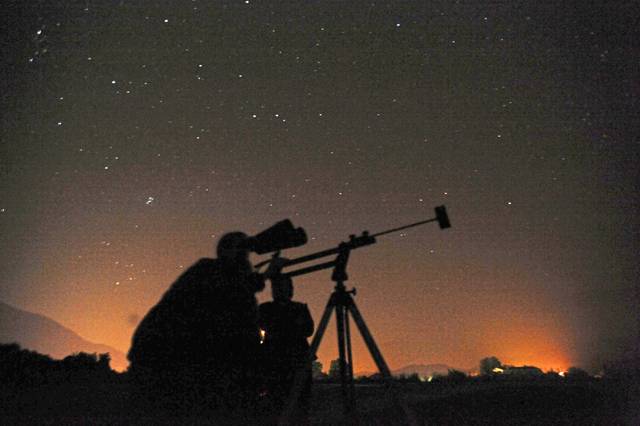
The annual Orionid meteor shower will light the night sky with around 20 meteors per hour visible across much of the globe, from after midnight until daybreak, according to AccuWeather.
Don’t plan to stay up until 2 a.m., though — prime viewing areas are not likely to include Western Pennsylvania.
“Unfortunately, we’re going to have a frontal boundary stalled over the area,” said Mike Kennedy, a meteorologist with the National Weather Service in Moon.
“That boundary will be sticking around through tomorrow, so we should have a good amount of cloud cover overnight and into Wednesday,” he said.
Tuesday night meteor-viewing will be best in the southwestern and south-central portions of the U.S. where mainly clear conditions are forecast. Some portions of the southeastern U.S. also should have favorable conditions for the peak night, AccuWeather says.
The Orionids is one of two annual meteor showers caused by debris left behind by Halley’s Comet, even though the comet itself only passes through the inner solar system once every 75 years. The other is the Eta Aquarids in early May.
Last seen in these parts in 1986, Halley’s Comet is next projected to swing by Earth in 2061.
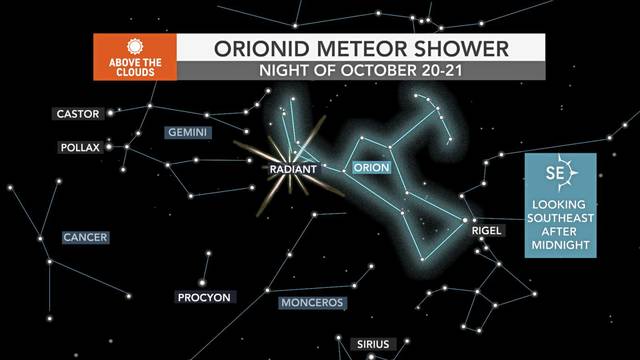
Though it has its origin in Halley’s Comet, the meteor shower takes its name from Orion since it appears to radiate from a point in the sky near the constellation.
Hardy folks who don’t mind standing outside in the cold may be able to see more meteors as winter approaches — the Leonids will peak on the night of Nov. 16 into Nov. 17, followed by the Geminids during the second weekend of December.
But that will depend on cloud cover on those dates too, Kennedy said.
“The Northeast has lots of cloudy days,” he said. “Off the top of my head, I want to say, there are only 30-some-odd days a year with minimal cloud cover.”